
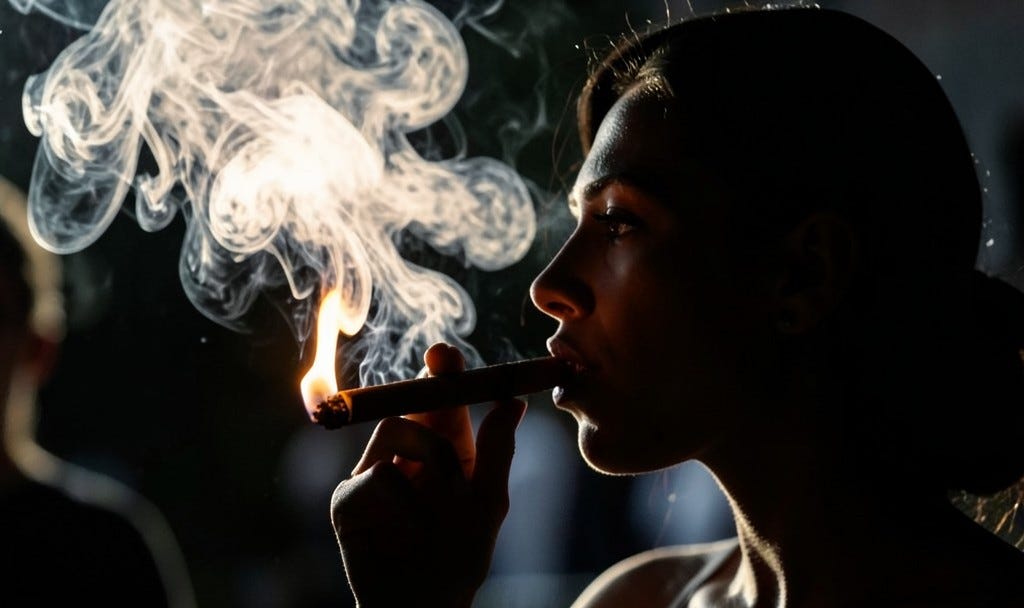
The ash was about an inch long when Alena reached for it.
We were on the patio in her and Rheanna’s backyard last week, for Denise’s birthday. Rheanna is Jade’s sister, nineteen years younger, and Denise is their cousin. It was the kind of August night where the heat has nowhere to go after dark and just sits on you. I was happy in the uncomplicated way I am rarely happy anymore, which is to say I was surrounded by people I love and nobody needed anything from me. Bruno was missing. He has been working late nights scooping ice cream at the mini-golf place in Lavallette, the last summer job before London. He drives himself there and drives himself home around midnight, sticky to the elbows and half asleep and sore in the shoulders, and delivers a nightly lament on the parenting habits of millennials who order their children coffee ice cream with caramel sauce and chocolate sprinkles at nine-thirty at night. I had already done the arithmetic on how few of those midnights were left.
In September, he goes to London to study costume design for film. He has been making clothes since he was small enough to need help with the scissors. He spent his whole school career building costumes for productions that had an actual wardrobe department, won awards for them, and finished as a senior running the department himself, a team of kids, everything from the hats down to the buttons. A dress form has been in his bedroom for years. I mention this because I am going to spend a few thousand words on the patience it takes to make a thing by hand, and the person who taught me most of what I know about that is eighteen and was, that night, scooping mint chip for someone’s overtired toddler.
So I took out a cigar. A Partagás Línea Maestra Origen, the Cuban one, a figurado with a rounded belicoso head that the magazine I will tell you about shortly had just scored 93 points and called the best of in the issue. Partagás is my brand, and I have stopped pretending to shop around. The name goes back to a factory in Havana in 1845, and how one of its cigars came to be on a patio in New Jersey is between me and the friend who handed it to me.
Jade, my wife, groaned. She does not hate that I smoke cigars. She hates everything else about them: the smell, the time, the way I talk about them, and she has made her peace with the habit the way you make peace with weather. Denise sniffed the air and said it smells like my Dad, in the tone of someone finding an old coat. Then Alena said the exact same words: it smells like my Dad, and meant the opposite. Her father is a fisherman and a cigar man, and the smell puts her back on a dock in Key West with him, and she leaned toward it instead of away.
I lit it. I moved to the far corner of the patio out of consideration for my wife, then hijacked the Bluetooth speaker and put on country music, with no consideration for anyone. Jade and Denise looked at each other and got into the pool, which is the correct response to both.
That left Alena, and Alena made the mistake of asking me about my cigar.
You should know something about me here, and my family will confirm it. When I love a thing, I have to tell you everything about it, whether or not you asked, and long after the point where a normal person would have read the room. It is the running joke of my life. Cigars are my dinosaurs now. I can give you the wrapper shades and the ring gauges in sixty-fourths of an inch, the difference between a leaf from the top of the plant and one from the bottom, and what happened in Havana in 1865. I will give it to you, on a patio, at a birthday party, to anyone who so much as glances at the thing in my hand. That is who I am socially. Anti-socially, Jade would say from the pool. This essay is what I did to Alena.
Somewhere in the middle of it, she said, “Can I try it?”
I should tell you now that this is a thing you never do, not in a lounge, not on a patio, not ever. A lit cigar is the one object in the world you do not pass. It has your mouth on it and your hour in it, and the etiquette on this point is older and firmer than most of the laws in this state. Men who will lend you their car will not lend you their cigar. I know all of this. I have read the books. I handed it to her without a second’s thought, because she asked, and because love is greater than decorum, and anyone who has ever been asked for something by someone they love knows the rulebook goes quiet at that moment.
She heard the title of this essay before I did, said it, and laughed. Then she did what everyone does. She looked around for somewhere to knock the ash off.
I said, “Don’t.”
She looked at me like I had asked her to hold a lit fuse, and I understood the look. Every piece of cultural training she had ever received about a burning thing in your hand says tap it. Tap it constantly. Tap it before it falls on your shirt. Tap it because a cigarette is a delivery system and the ash is exhaust.
A cigar works the other way round. The ash is not waste. It is a cap. It sits on the coal and slows the air getting to it, which keeps the burn cooler, which keeps the smoke sweeter, which keeps the tar and the bitterness where they belong: nowhere near your mouth. Knock it off, and the cherry flares, the temperature climbs, the leaf scorches instead of toasting, and the thing turns harsh in about three draws. The ash is a buffer between you and the fire. You let it build. You let it get long and a little frightening. You let it fall when it falls.
She held it wrong, she drew on it right, she coughed, she laughed, and she said, “So you just wait?”
“Yes. You just wait.” I said.
I have spent three years telling boardrooms a version of this about AI. That friction is form. That the effort a thing asks of you is not separate from the meaning it gives back, and that when the machines take the effort, the meaning tends to leave with it. I have slides. It took a sister-in-law on a patio, with her wife’s cousin in the pool, to say it in five words.
The stupid, annoying, unhealthy thing
Let me get the confession out of the way, because I know how this reads.
I am fifty-six. My friends are getting old in the specific way where you notice it at dinner. The reading glasses. The hair that is a shade too even to be true. Somebody’s back. And the exhaustion that arrives with the entrees now, so that by the time the check comes, half the table is already home in their heads. My son leaves for university in a few weeks. Rheanna, whom Jade and I have been raising in one way or another since she was small, alongside their mother, whom I have moved to live near us more than once and who is helpful in the way the mothers-in-law on The Sopranos are helpful, which is what you get when you marry into North Jersey royalty, married a woman I adore this year. I walked her down the aisle to Alena. The two of them are building a house full of a life I get to visit. By every metric I used to care about, I’m doing fine. Two companies. A book out to publishers. A column. A wife who still laughs at the same jokes I have been telling since Hoboken.
And I have taken up cigars.
People hear this, and they do the arithmetic quickly. Midlife. Mortality. A man who spent thirty years building machines that remove effort from the world, and now spends his days in rooms where the machines are learning to remove the rest of it, suddenly needs a ritual that is all effort. They are not wrong. I would only add that being predictable is not the same as being mistaken.
Cigars are stupid in the sense that they do nothing. They do not make you faster, thinner, richer, or smarter. They are annoying because they take ninety minutes and stink up your jacket. They are unhealthy in the sense that tobacco is tobacco and I am not going to sit here and tell you the smoke I do not inhale is good for me. It is not. I am an adult, and I have run those numbers, and I have decided that ninety minutes, a few times a week, sitting still with a thing I cannot rush, is worth what it costs. You are allowed to disagree. That is the last time in this essay I will mention it, which I suspect is more than the nicotine pouch industry has ever said to you.
Because that is the real comparison, I am not writing this against clean living. I am writing it against the pouch. The little white pillow that goes between lip and gum and delivers the molecule in eleven seconds with no smoke, no smell, no ritual, no wait, and no reason to ever be anywhere in particular while it happens. It is nicotine with the friction removed. It is the thing we have done to everything.
The man who runs Davidoff, a Swiss executive named Beat Hauenstein who started as the company’s IT guy, put it better than I can. He told the magazine he took up cigars in 2005 after quitting cigarettes, and described it as switching from nicotine to pleasure. Same molecule. Different transaction. One is a dose. The other is an hour.
The reader on the platform
I read Cigar Aficionado on my own front porch, with a cigar going. That is the only place I read it, and the July issue was the one with Luke Bryan on the cover. It has become part of the ritual in a way I didn’t plan, and it took me a while to understand why, so bear with me for a little history.
In December of 1865, in a Havana factory called El Fígaro, a roller and poet named Saturnino Martínez, who had just started a newspaper for cigar workers called La Aurora, arranged for one man to read aloud to the floor while everyone else rolled. The lector. The rollers chose him and paid his wages out of their own pockets. He sat on a raised platform above the tables and read the papers in the morning and novels in the afternoon, and the rollers voted on the novels. Hugo. Dickens. Zola. Cervantes. A month later, the American Secretary of State, William Seward, toured the Partagás factory, my brand, and wrote about the profound silence of a room full of men working with their hands and listening to a book. When the trade moved to Key West and then to Tampa, the readers moved with it, and in Ybor City men who could not write their names could argue about Les Misérables at lunch.
A room of people doing slow, skilled, repetitive work with their hands, and instead of numbing the work, they decided to fill it. They put a human voice in the room and paid for it. The factory owners hated it, of course. The lectores read labor news and Marx, and the rollers organized. By 1931 a Tampa roller was paying a quarter a week out of a fifteen-dollar wage to keep his reader, and that November the owners tore the platforms out of the factories. Seven thousand workers walked out over it, not over money, over the reading. The owners locked the gates until hunger did the rest. The radio took the platform after that. Then nothing did.
That is the arc I keep seeing everywhere now. Skilled work, filled with meaning by the people doing it. Then an efficiency, sold as a gift. Then a silence where the voice used to be.
So the magazine is my lector. Half of it is watches and golf resorts, and I skip that. The other half is the only place I have found where the slow world writes about itself in its own voice. This issue has a letter from a man in Lake Bluff, Illinois, turning eighty, who says he cannot type and smoke at the same time, and does not want to do anything. In contrast, he smokes, and that choosing the cigar and cutting it and toasting the foot are his preparation for what he calls a quiet meditation. He closes with a line I have been carrying around for a week: “Life without small pleasures is no life at all.” The letter under his is from a man who describes cigars as his sanctuary and a break from the noise, and I looked at the signature, and it was from Point Pleasant Beach. He could have been writing from the next porch over.
That is what the reader on the platform did. He told the people doing the slow work that they were not alone in it.
What it takes
Here is what has to happen before I can sit on a patio, or my own front porch, and wait.
Somewhere in the Jalapa Valley or Estelí in Nicaragua, or the Cibao in the Dominican Republic, or the Vuelta Abajo in western Cuba if we are being romantic about it, a farmer plants a seed the size of a grain of dust. Tobacco seed is absurdly small. A single ounce holds hundreds of thousands of them. They are started under cover, transplanted by hand, and grown in a few months into a plant taller than a man.
The plant is not harvested. The leaves are, from the bottom up, a few at a time, over weeks. Each position on the stalk has a name and a job. Volado from the bottom, thin and mild, there to burn. Seco from the middle, the aroma. Viso above that, oils and some strength. Ligero from the top, where the sun hits hardest, thick and dark and full of the plant’s whole argument, slow to burn and placed at the very center of the cigar so it does not go out. A blender is choosing from these the way a composer chooses from sections of an orchestra. The wrapper leaf, the one you actually see, is often grown somewhere else entirely under tents of cheesecloth, in the Connecticut River Valley or in Ecuador where the cloud cover does the shading for free, because a wrapper has to be thin and perfect and without a vein that would spoil the burn. Hauenstein says it can take Davidoff ten years to develop a new wrapper—ten years to arrive at a leaf.
The best cigar in this issue, the one the editors gave 94 points, is a Plasencia grown thousands of feet up in the Condega hills of Nicaragua. Their word for why it is good is the same word real estate agents use. Location. The same plant, from the same seed, tastes different a few hundred feet higher, and the whole industry is organized around the fact that nobody can fake that from a lab.
Then the leaves hang in a curing barn for six to eight weeks and turn from green to gold to brown. Davidoff pre-pays its Dominican farmers for better barns, because the barn is where the leaf becomes tobacco or becomes hay. Then the leaves are stacked in pilones, big piles that heat up from the inside like compost, and turned by hand when the core hits a certain temperature, and stacked again, and turned again, for months. That is fermentation. It is what takes the ammonia out. Skip it, and you get something that tastes like a barn fire. Then the leaves are baled and aged. One year. Two. Five. Davidoff is sitting on 2,600 tons of fermented tobacco right now, and the reason is that the Davidoff 2000 you buy this year has to taste like the one you bought last year, and the only way to promise that is to own the past. Rocky Patel’s Vintage 1990 uses tobacco that is twelve years old, the same age it was when the line launched in 2002. The vintage is not a year. It is a wait.
Then a torcedor, a roller, who has typically spent years learning to bunch the filler so it draws right, takes two or three or four different leaves, folds them into a bunch, wraps a binder around it, presses it in a mold, and lays the wrapper on with a crescent blade called a chaveta, cuts a cap from a scrap of the same leaf, and glues it on with vegetable gum. A good roller makes maybe a hundred and fifty in a day. Each one is checked for draw on a machine that measures resistance. Then the finished cigars go into aging rooms again, for months, so the three or four tobaccos inside stop being three or four things and become one thing.
Then someone puts a band on it, puts it in a box, and it comes to a shop in Bergen County, and I pay what I pay, and I take it home, cut it, toast the foot, light it, and wait.
Two years, minimum, from dust to porch. Hundreds of decisions, most of them made by people whose grandparents made the same decisions with the same hands. J.C. Newman in Tampa and Arturo Fuente in the Dominican Republic have, between them, two hundred years of doing this, and they make one cigar together. Nothing in that chain can be hurried. You cannot ferment faster. You cannot age faster. You cannot roll faster without ruining it. The friction is not a flaw in the process. The friction is the process. Take it out and you do not have a cheaper cigar. You have a pouch.
I will give Davidoff one more paragraph because they handed me the perfect small confession. Their fast-growing budget line, Zino, now comes pre-cut. The CEO admitted he resisted it because he likes the ceremony, and then said he learned from consumers that they just want to light it and go. There it is, in a sentence. A man who loves the ritual, selling its removal because the market asked. I do not blame him. I have shipped that feature myself, in other industries, under other names, more times than I can count.
The old smoke
Tobacco is not old the way wine is old. It is older than anything Europe has a word for.
The Taíno in Cuba were rolling dried leaves in palm and smoking them when Columbus arrived, and their word for it, depending on which account you trust, was cohiba. One of his men, Rodrigo de Jerez, brought the habit home and, the story goes, was jailed by the Inquisition for the smoke coming out of his mouth, which is either true or the kind of thing that should be. Across the Americas, the plant was sacred long before it was commercial. Maya priests blew it. Shamans in the Amazon still use it to see. It was medicine, offering, and a way of speaking to whatever is on the other side of the smoke. It was never once, in any of those cultures, a thing you did fast.
Spain ran the trade out of Seville for two centuries, in a factory the size of a fortress. Cuba took it away, because the soil in the Vuelta Abajo turned out to be the best tobacco soil on earth and nobody has ever entirely figured out why. Then Key West, then Tampa, then the Dominican Republic and Honduras and Nicaragua after Castro, when the great families left Cuba with seeds in their pockets and started over in Santiago and Danlí and Estelí. Kennedy, the night before he signed the embargo in February 1962, sent his press secretary Pierre Salinger out to buy every Petit Upmann in Washington. Salinger came back with twelve hundred. Then the president opened his desk and signed. That is Salinger’s own telling, in the first issue of the magazine I read on the porch, and nobody has ever produced a record to contradict it. A man who understood the difference between policy and a good cigar.
Cuba is still at it, barely. The magazine’s report from Havana this month reads like a dispatch from a siege. Oil shortages. Blackouts across the island. The annual festival postponed. And yet the state cigar company keeps trickling out new releases one country at a time, a Montecristo at a hundred and forty dollars a stick, a Cohiba that works out to more than five hundred. The Origen I was smoking on that patio came out of that same darkness. The lights are off, and the rollers are still rolling. I do not know whether that is tragic or magnificent. Probably it is both, which is the Cuban condition.
You can hold all of that in your hand. That is the point of the band, I think, though nobody says so. Five centuries of other people’s patience, rolled up, waiting for yours.
Thirds
A cigar smokes in thirds, and I did not believe that until I paid attention.
The Origen has a pointed head, which means you cut it with scissors, and I own a lighter with a pair of scissors folded into it, which is the kind of object that exists only for people like me and which I will show you if you stand still. Snip the point, toast the foot, draw. The first third of that cigar was cream. I do not have a better word. Cappuccino, hazelnut, some wood, cinnamon at the end of the draw, all of it wrapped in a texture that coated the mouth instead of scraping it. Bright and a little separate, the way a first third is, the wrapper doing most of the talking and the coal still finding its temperature. You are still deciding whether you like it. I had decided.
The second third is the conversation, and this is where Alena walked over. The tobaccos had blended in the heat, a leather note had come in under the cream, and the strength had started to climb, not dramatically, a notch, the way the volume goes up in a room without anyone touching the dial. The burn line was straight as a laser, which tells you the roller in Havana did his job. Handing it across the table did not cost it anything. That is the other reason you never do this, by the way, and I did it anyway. This is the third where you stop noticing that you are smoking and start noticing what you are thinking. This is where I do most of my actual work now: deciding what I think, which no machine has been able to take from me yet because I do it with my mouth shut, a lit thing in my hand, and no keyboard within reach. That night the work was explaining all of this to Alena, who had asked, and who kept asking, while Jade and Denise stayed in the pool and Rheanna sat at the far end of the patio watching the dogs wear themselves out in the grass.
The final third is the reckoning. The smoke has been passing through the tobacco behind it for an hour, picking up oils and tar, and everything gets stronger and darker; sometimes it turns, and you put it down; sometimes it deepens, and you sit with it to the nub, your fingers getting hot. You do not know which until you are there. Nobody does. You can read every review of the blend, and you will still not know how your last inch goes. The Origen deepened. It did not turn. I took it down until the heat in my thumb and index finger was hotter than the August air on that patio, which is the only reason I stopped, and I put it in the tray, and it kept going for a minute on its own, the way they do, as if it had one more thing to say.
The magazine has a page at the back where the editors smoke very old cigars. This month, one of them lit a Don Candido from around 1970, a brand that has been dead since the eighties, and reported that the first few puffs were woody and dusty and that it took some patience; then it opened into roasted chestnut and almond paste and, of all things, gingerbread. Fifty-six years in a box, and the thing still had a first third that made you wait and a second third that paid you back. Another editor revisited a Montecristo from 2016 that he had scored 90 a decade ago and found it better now, and closed his note with two words. Worth the wait.
Forrest Gump’s mother told him life was like a box of chocolates. I have come to think she was being kind. A box of chocolates is a menu of small, sealed surprises, each one over in a bite, and if you do not like one you spit it out and reach for another. That is the pouch again. That is the feed. That is every app on my phone.
Life is a lot more like the cigar. It has a first third where you are mostly wrapper and bright notes and not yet sure. It has a long middle where the blend takes over, and the ash builds, and if you are wise, you do not touch it. And it has a final third that is stronger than you expected, and you cannot skip to it, and you cannot skip past it, and how it goes depends almost entirely on what you did with the middle. I am in the second third. I am, by that editor’s arithmetic, roughly the age of the Don Candido. I can feel the ash getting long. Everyone I love is telling me, in one way or another, that they are about to fall. Bruno to London, by way of an ice cream counter in Lavallette and a dress form he will have to leave behind. My friends to their glasses and their early nights. Rheanna, whom I walked down an aisle, into a marriage that will, correctly, need me less than the years before it did.
The instinct is to tap. To knock something loose. To do something. Cigars have taught me, in a few months, what the last thirty years of shipping software did not. Let it build. The ash is protecting the fire.
The industry nobody is watching
You would think a thing this slow would be dying. It is doing fine.
The United States imported just under 430 million premium, handmade cigars in 2025, according to the Cigar Association of America’s figures as reported by Cigar Aficionado, the fifth straight year over 400 million. As recently as 2019, the number was 338 million. Nicaragua alone shipped roughly 60 percent of them. The machine-made end of the business, the gas-station cigarillos, is shrinking every year. The handmade end is holding. The cheap stuff is losing. The slow stuff is not.
I find that quietly encouraging. In the middle of the great frictionless flattening, where everything is optimized to arrive faster and demand less, hundreds of millions of people a year are paying a premium for a product whose entire value is that it cannot be hurried. Hauenstein says his customers include blue-collar guys who skip lunch to afford a Davidoff. Nobody is putting any of this in a pitch deck. There is no cigar unicorn. It is a heritage industry run by families in three small countries, with hand tools, and it is beating the pouch on margin.
Every year, there is a festival in Santiago, Dominican Republic, where the factories throw their doors open and let visitors plant a seedling with their own hands. This year’s slogan was “Our Soil and Soul.” On the last night, the makers auction humidors for charity, and the Fuente family’s went for a hundred and fifty thousand dollars, bought by a rival who flew in from Nicaragua for the privilege. The outgoing president said they are competitors and also friends, and that no other industry works like that. I have been in a lot of industries. He is right.
The pouch on the conference table
Meanwhile, the pouch sits on the counter next to the register, twenty little pillows to a tin, engineered to be invisible. You can use it in a meeting. You can use it on a plane. You can use it while you prompt. That is the sales pitch. Nothing about it requires you to stop.
And now it sits on the conference table. Wired ran a piece this spring on the tech founders and their pouches, and if you have spent time in the rooms I have spent the last decade in, none of it surprised you. A 26-year-old software founder keeps a six-milligram mint Zyn under his lip for every waking hour of a fifteen-hour day, pausing to eat. He used to think the habit was degenerate. Then every founder he knew started doing it, and now, by his count, every one of his friends who runs a company runs it with a pouch in his mouth. He swaps his out every three hours, when the flavor is gone, so that he is never not stimulated on a sales call and can read the microexpressions across the table. His test is whether it helps him make more money and work more efficiently. Each pouch carries the nicotine of several cigarettes. The reporter’s word for these men was racehorses.
Zyn belongs to Philip Morris, which shipped something like 794 million cans of it in the United States last year, up 37 percent. The company’s own scientist told Wired that cigarettes are a twentieth-century delivery method, which is a remarkable thing to hear from Philip Morris, and also that the science does not actually support the founders’ claims about focus. The founders did not ask him. The Wall Street Journal reported in January that startups now hand out pouches alongside protein bars, and that Palantir keeps two pouch vending machines in its Washington office, free to anyone over twenty-one. Wired called that a labor-relations milestone on the order of nineteenth-century factory owners first allowing a smoke break. I would put it differently. The smoke break was the workers taking ten minutes back from the owner. The vending machine is the owner taking the ten minutes back. The perk is the dose. The company is not buying you a pleasure. It is buying your afternoon.
The rest of the cast runs from a flow-state coach who cycles his nicotine in four-week blocks to Tucker Carlson, who is my age, selling a brand called ALP, for American Lip Pillow, and cheerfully admitting it is addictive. The one I keep coming back to is Nick Bostrom, the philosopher who wrote Superintelligence and taught a generation of these founders to worry about machines. He takes his nicotine on a coated toothpick, because the pouches seem yucky to him and he wants the molecule pure, and he allowed, with what the reporter describes as a hint of sarcasm, that there is “a kind of coolness in being like, ‘Yes, I’m a machine.’”
I want to be careful here, because the easy version of this paragraph is an old man on a porch sneering at young men in an office, and I ran an office. I have been the guy who wanted the afternoon. I have sat at those tables. If someone had put a bowl of clean, smokeless focus in the middle of one in 2010, I would have reached for it and told myself it was coffee, which is exactly the defense the Journal’s sources gave, and it is not a stupid defense. It is just the wrong one, and the reason it is wrong is the argument of this essay.
Look at what the pouch is—tobacco-free nicotine salt, artificial sweetener, synthetic fiber. No leaf. No priming, no barn, no pile turned by hand, no torcedor, no ten years to arrive at a wrapper. Five centuries of people working out how to grow and cure and age and roll a plant so that it would give you an hour, and the end state of that entire lineage is a white pillow with the plant removed. Same molecule. The friction is gone, and the friction was what made you stop. Hauenstein said he switched from nicotine to pleasure. The founders in that article made the trip in the other direction, from pleasure back to nicotine, and called it optimization. Bostrom, with his toothpick, is just the purest version of the same move. He wants the molecule with nothing else attached. The cigar is the opposite bet. It is everything else, with the molecule attached.
The rollers in Havana paid a man out of their own pockets to read novels to them while they worked, because the work was slow and they wanted it to mean something. The founders in Palo Alto are handed a stimulant by their employer so the work can go faster and mean less. That is the century in two rooms. One had a voice on a platform. The other has a vending machine. And the Swedish dentist who told the BBC about gum lesions deep enough to see the roots of the teeth is only telling you what the ash would have told you for free, which is that a burn with no buffer goes straight to the bone.
Asked whether the pouches might turn out to be the next vape, the founder with the fifteen-hour days shrugged and said maybe, and that if so it would be like, oh no, that was a mistake. Then he admitted he reaches for one on his days off. That is a man watching the ash fall on its own and not knowing what he is looking at.
Nobody in that article is going to sit on a porch for ninety minutes with a thing they cannot rush. That is not a moral failing. It is a design outcome. They have been handed a product whose entire purpose is that you never have to be anywhere while it works, and they are using it as directed.
No smoking
There are no smoking sections anymore, and I have come to love that.
I mean it. The bars, the terminals, and the back rooms of restaurants where smoke was permitted are gone, and I do not want them back. What I want is what their absence gave me: the obligation to go find a place. A front porch. A corner of a parking lot behind a shop. A bench at the far end of the boardwalk at the hour when the boardwalk belongs to the gulls. Luke Bryan, on the cover of the issue and for all I know on the Bluetooth speaker that night, says his version is a day off, the truck windows down, driving around his farm with one lit. Even the country star has to leave the sanctioned space. I have to be somewhere the machinery of convenience did not think to reach, because the machinery of convenience is, by definition, indoors and connected and on.
That is what friction is for. I said it at the top, and I have said it in print for years. Friction is form. I stand by every word. But I wrote most of it at a desk, in front of a screen, in the sanctioned space. I was describing friction from inside a frictionless room.
The cigar got me out of the room and onto the porch.
Here is the inventory, the way I like to close these. In the last year I have delegated my calendar, my first drafts, my summaries, my research, my inbox triage, my directions, my playlists, and, if I am honest, a good part of my remembering, to systems that do those things faster and never ask me to wait. Each one was a reasonable trade. Each one took a little ash off the coal.
What I have not delegated, what I cannot, is the ninety minutes on the porch. The seed, the barn, the pile, the roller, the reader on the platform, the band, the cut, the toast, the first third, the long grey second, the final inch. Nobody can smoke it for me. No model can summarize it. It does not ship. It is the most inefficient thing I do all week, and it is the only thing I do all week that is entirely mine. Davidoff’s motto, printed on the last line of the interview like a mission statement, is three words. Time Beautifully Filled. I would only strike the middle one. Time, filled. That is the product.
Alena handed the cigar back, which is the other thing you never do, and which I took. The ash had made it. I let it fall on its own, into the tray, whole, a grey cylinder that held its shape for a second before it went, and the coal underneath was bright and even and ready for whatever the last third had in mind.
“So you just wait?” she had said.
Yes. That is the whole trick. That is what I have been trying to say.
Very fine substack especially with a Partagas Serie D No. 4 or a Davidoff Special R in the backyard. 45 minutes of quality time. Thank you very much.