
The Daily Mail found me on the porch at the shore, on Labor Day, when the town gives itself back to the people who pay its taxes. The headline said a medical scientist had broken ranks. It said human DNA carries evidence of an intelligent creator. I know what the Daily Mail is. I clicked anyway.
For about ninety seconds, it worked on me.
I need you to understand why that is embarrassing. I write about tells for a living. I have spent this year arguing that the scarcest resource in AI is the ability to know when you are being worked. And there I sat with the ice cubes melting in my cold brew, wanting a tabloid to be right, because I have believed a version of its conclusion since I was eight years old.
My mother dragged me to antique shows and house sales all over Northeast Ohio. Church basements, dead men’s garages, fancy stores filled with delicate people in Chagrin Falls and Shaker Heights, banquet halls with folding tables and cigar-box cash registers. She went for the glassware. I went straight to the watches and stayed there for hours, a small boy bent over the cases like a jeweler with no inventory. Worn devices that had marked the lives of strangers, wound by hands that were gone, discarded now, unwanted, available at a negotiable price. Filled, I was certain, with evidence of God.
Consider what a watch is. A man sits at a bench with tools, magnification, and patience, and from a solid piece of metal he builds an instrument that tracks the universe and a life. Then consider what these particular watches had tracked. Births and deaths. Weddings. Sadness and joy. Christmases and summer holidays, all of them timed to the second for strangers I would never meet, on wrists that had gone into the ground while the watches kept running. I stood at those tables and felt every one of those strangers connected to me at some level smaller than atomic and greater than quantum. That is a child’s physics. I have since learned enough real physics to fail the sentence on inspection, and enough of everything else to keep it.
So when a man with a doctorate in medicinal chemistry told the Daily Mail that the code in our cells provides evidence for intelligence, some eight-year-old in me stood up. Then the fifty-six-year-old went looking for the paper.
There is no paper. There is a book. Orson Wedgwood, DNA: The Elephant in the Lab, self-published in January 2019, sixty-seven thousand words, shelved by its own distributor under Religion and Science. The tabloid piece running seven years later as an exclusive is a press cycle, and the man breaking ranks was never in the ranks he is breaking from. I bought the book anyway. I bought it twice, actually. The first store sold it to me and then kept it, the way ebook stores do now, readable only inside their walls, mine in the sense that a hotel room is mine. The second store let me carry it out. Evidence of God, $7.99, twice. At the folding tables, the price was at least negotiable.
The book’s centerpiece is a number. Wedgwood calculates the odds of a single working protein assembling by chance at one in ten to the 164th power. That number has 164 zeroes. The universe, he notes, only ever had the capacity for ten to the 120th tries. Case closed, he says, and to be fair, it would be, if anyone anywhere claimed the game was played that way.
The calculation models a lottery: all 150 characters of the password guessed at once, every miss resetting to zero. Chemistry plays a different game. Chemistry keeps its winnings. Anything that copies itself, however badly, starts an audit trail, and every improvement is locked in before the next guess.
The load-bearing piece of his number is an estimate that only one sequence in ten to the 74th will fold into anything useful, a figure arrived at by mutating a single modern enzyme until it broke and extrapolating outward. In 2001, Jack Szostak’s lab at Massachusetts General ran the direct experiment instead, building a library of trillions of genuinely random eighty-amino-acid sequences and fishing out the ones that could bind ATP. They found four.
The rate worked out to roughly one in a hundred billion. That is a test tube’s worth of luck standing sixty-three orders of magnitude away from the number the book is built on, and the book is made of that gap.
But the number is a sideshow. The real merchandise is a sentence.
In bold, in the book’s early pages, sits a line from a 2017 opinion piece in Nature Reviews Chemistry by John Sutherland of Cambridge, one of the two or three most important origin-of-life chemists alive. Sutherland’s piece carried the title “The end of the beginning.” That is Churchill, after El Alamein, declaring the war’s first won battle. Sutherland’s own lab had just shown how the building blocks of life, the parts for RNA and proteins and cell membranes, could all emerge from the same simple cyanide chemistry on the early Earth. His piece said the field remains far from the finish and “may have nearly finished the first phase: the beginning.” A victory speech, carefully hedged, from a man in the middle of winning.
The book bolds the hedge and calls it a confession.
So I walked the sentence upstream, and here is its chain of custody. January 2017: Sutherland publishes measured optimism under a victory title. July 2017: the Discovery Institute’s house blog runs the piece under a headline announcing that an origin-of-life researcher “admits” the road is long, dismissing Sutherland’s actual view as overly optimistic. 2019: the self-published book inherits the inverted reading, bolding included. September 2026: the Daily Mail sells it to the world as a scientist breaking ranks, and a man on a porch in New Jersey nearly buys it in ninety seconds flat. Nine years. Four owners. The meaning flipped at the second handoff and stayed flipped, because every layer cited the layer above it, and nobody walked back to the source. The inversion traveled the whole way free of charge. Checking it cost me $15.98, one blocked crawler, and a journal paywall asking $39.95 for a paper whose abstract was the entire crime scene.
Here is what I hold against the book, and it has nothing to do with God.
The watchmaker at his bench made an honest instrument. Whatever else you believe about him, the watch tells the time that is actually passing. The book is a rigged instrument, a movement assembled to read a predetermined hour: the lottery that models no known process, the quote inverted against its own title, the citation to a journal one notch more famous than the real one. And a rigged watch insults in both directions. It cheapens the science it impersonates, and it cheapens the God it is offered to, who presumably has no need of doctored evidence and has never once been found inside a gap that stayed closed.
Because what I had at the folding tables was never a proof. That is its entire strength. Nobody can flip my quote or audit my math. There is no math. I don’t believe it because the odds are ten to the 164th against. I believe the way you recognize a face. I know what pareidolia is. I also know what I saw.
I am standing in a very old line, too. The watch may be the most contested object in Western theology, handed down for two thousand years with the meaning flipped at nearly every handoff. Cicero started it before there were watches, arguing that a man who looks at a sundial or a water-clock understands at once that somebody intended it. A country clergyman named William Derham published a nuts-and-bolts manual on watch and clock construction in 1696, having taught himself the craft by pestering Hooke and Tompion, and then argued God from the design of Nature in Physico-Theology in 1713, one man writing both the how-to for the bench and the sermon of the bench. I would trade most of the canon for his library card. Paley found his watch on the heath in 1802 and gave the argument its famous form. Dawkins picked the same watch up in 1986 and blinded the watchmaker, in the open, on the cover, under his own name.
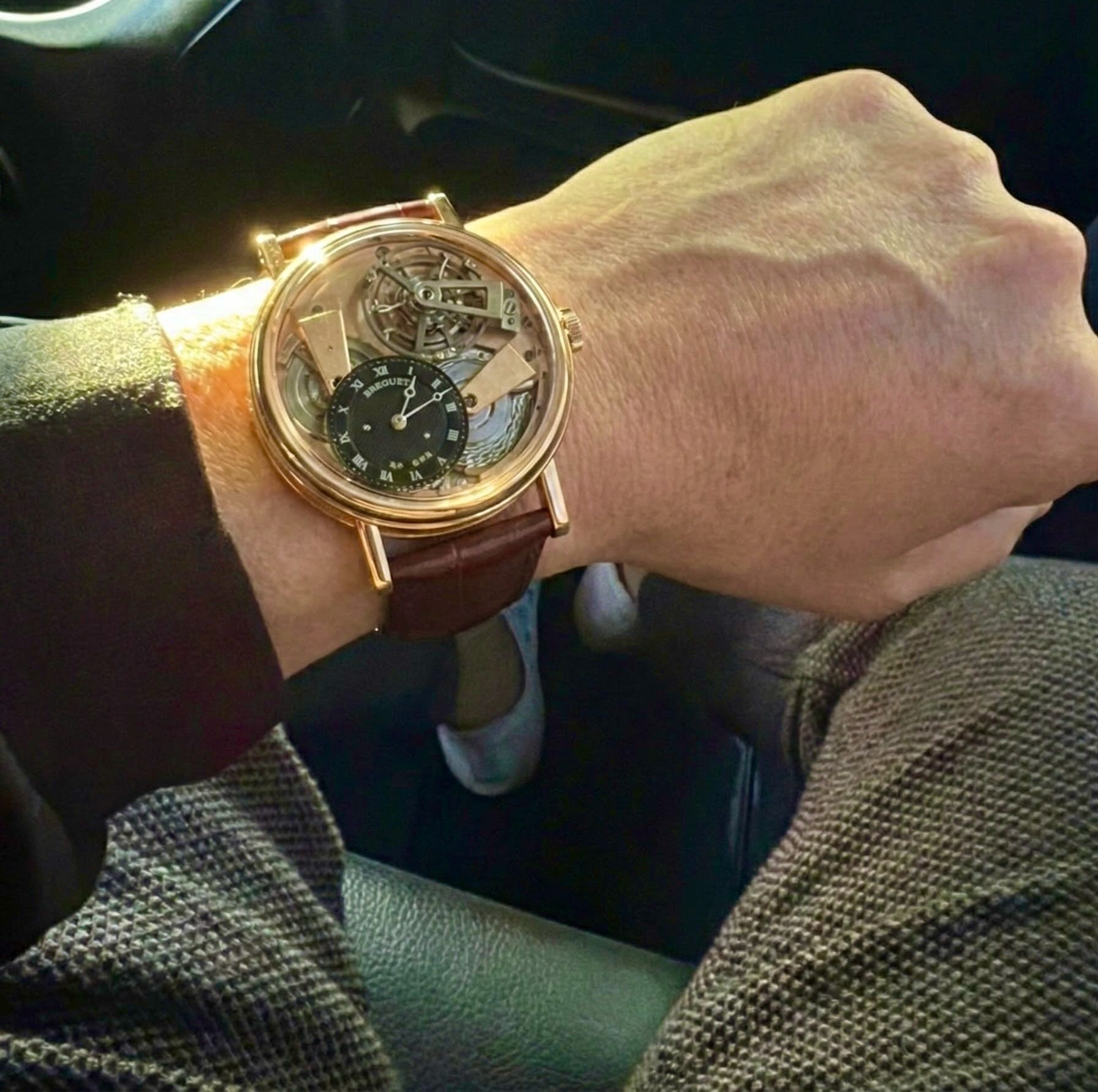
Every man in that line was arguing about a watchmaker. Not one of them was a watchmaker. Derham came closest, and he was a parson with a hobby. The genuine article was alive while the most famous version of the argument was being written, over in Paris, and his name was Abraham-Louis Breguet. He patented the tourbillon on the 26th of June, 1801, one year and one country away from Paley imagining his. Breguet was faked so relentlessly in his own lifetime that he had begun, back in the 1790s, engraving a secret signature into his dials, nearly invisible, a diamond point dragged through the surface, showing itself only when the light rakes across at the right angle. He had brought guilloché to the dial face in 1786 partly for the same reason. Every Breguet made since carries the signature, including the one on my wrist as I write this. The greatest watchmaker who ever lived built the authenticity check into the face of the instrument, because he knew precisely what was coming for it. The answer he landed on two centuries ago is still the only answer there is. Put the proof in the object, where anyone willing to turn it to the light can find it.
Dawkins is still the one I owe an answer to, so let me pay him properly and not with a straw version. Selection is a complete account. It requires nothing added from outside, no nudge, no first push, no debt to anybody. Anything that copies itself with errors will climb, and the climb is not random; given four billion years and an ocean, it produces eyes and wings and the ribosome and the man at the bench. I described that ratchet myself a few paragraphs ago to knock down a rigged number, and I meant every word of it. Then I sat down and watched a machine write three hundred genomes with no mind involved in any single choice, and sixteen of them lived. If you want the strongest case that watch-like things arrive without a watchmaker, I have been handling the evidence all day, and I will hand you the file.
I see it anyway.
That is the whole confession. Not an argument, and I am not offering it as one. I am telling you that a man who spent this week auditing a design argument down to the studs, who can show you exactly which zero the fraud lives in, still stood at those tables at eight years old and knew what he was looking at, and stands at his bench at fifty-six and knows it again. You may file that under pareidolia. I would only ask you to notice that the same faculty that sees faces in clouds is the one that recognizes your mother across a parking lot, and nobody has ever proposed we switch it off.
Notice what that is. A chain of custody, two millennia long, the object passed on and inverted again and again. The difference between that chain and the one that carried Sutherland’s sentence is that every man in it signed his inversion. The tradition is one long honest argument. The laundering was a forgery. You are allowed to turn an inherited object over in your hands and read it against its previous owner. You are required to say that is what you are doing.
And I still see it, most days, at my own bench. I grew up into the man with the tools and the magnification, except the metal now is data: raw records, millions of them, unverified, each one claiming to describe a life. The work is the watchmaker’s work. You take the raw form, and you make it into something that can measure and mean, and you check the record before anything downstream is allowed to trust it, because a better model trained on unverified records is a better way to be wrong. That sentence is the whole trade. It also describes the chain that carried Sutherland’s sentence for nine years, and it describes what happens next, at scale, when the machines do the reading. Einstein described the physicist’s condition as a man studying a watch whose case can never be opened, free to imagine the mechanism, never able to check his picture against the works. He wrote that in 1938. We have since built the closed watch ourselves and taught it to speak, and it imagines its mechanism from whatever we feed it. The models are eating the downstream copies right now. Unless someone walks upstream on their behalf, they will cite the confession and never find the victory speech, fluently, confidently, forever.
The watch is only the latest answer to a very old question, and the older answers are stranger than most people suspect. Until the railroads, every American town kept its own noon, clocks set to the sun directly overhead. Hence, Pittsburgh and Philadelphia disagreed by minutes and nobody minded until the timetables made them.
In industrial England you could hire a knocker-upper, a human alarm clock paid a few pence a week to rap your bedroom window with a long pole or shoot dried peas at the glass until you stirred, and the trade’s own riddle asked who knocked up the knocker-upper. Sailors told speed by throwing a knotted rope off the stern and counting knots against a sandglass, which is why ships still travel in knots. Sailors died by the thousand for want of a clock that could keep true time at sea, until John Harrison, a carpenter with no formal training, spent his whole life building one accurate enough to find you on the ocean.
Alfred the Great burned marked candles, six to see him through a day, and when drafts made the flames run fast and lie to him, he built them a lantern of wood and translucent horn to keep them honest.
The Chinese built incense clocks that burned a different fragrance each hour, so you could wake in the dark and smell the time.
In Athens the courtroom clock was a clepsydra, literally a water thief; a lawyer was allotted so many jars, and when your water ran out, so had your argument. For most of human history the hour itself would not hold still.
Rome and medieval Europe cut daylight into twelve hours whatever the season, so a summer hour swelled and a winter hour shrank, and the hour fit the day instead of the day fitting the hour.
Galileo, bored during a service in the cathedral at Pisa, timed the swing of a hanging lamp against his own pulse and founded the physics of the pendulum on a heartbeat, in a church. The story comes from his first biographer and is probably polished, and in this essay of all essays I am obliged to tell you so. And when there was no instrument at all, people timed the world in prayer. Cooks were told to boil the egg for the length of a Miserere and to stir for an Ave Maria. The prayer was the unit.
One more walk upstream, the longest one.
The mechanical clock was born in medieval monasteries, built by monks who needed to be woken for the canonical hours, machines made so that men would not be late for prayer. Lewis Mumford argued in Technics and Civilization that the clock, and never mind the steam engine, is the key machine of the industrial age, and it was invented in the service of worship. Follow any watch’s provenance far enough, past the estate sale, past the factory, past the guild, and you arrive at men building machines to call one another to God. The boy at the folding table had no idea he was holding an object whose original spec was prayer.
The walk forward ends in a vault.
Since 1967, the second has not been a slice of daylight at all. It is 9,192,631,770 oscillations of a cesium atom, the same count in every laboratory on Earth, the definition of time lifted off the heavens and set inside a single element. The best of these clocks now run so true they would not slip a second in the lifetime of the universe. Raise one a foot off the bench, and it ticks measurably faster, because gravity is weaker up there, and the instrument has become fine enough to see Einstein in the space above your desk.
And we still check it against the world.
The Earth is a sloppy timekeeper, wobbling, dragging on the tides, and lately spinning a hair faster, so since 1972 the keepers of time have inserted leap seconds into atomic time to keep the count true against the planet’s actual turning. Twenty-seven of them, the last one in 2016. The most precise instrument our species has ever built gets corrected by the thing it measures, and that correction is the entire definition of an honest instrument.
In November 2022, the international body that governs the second voted to abolish the leap second by 2035, largely because the correction wreaks havoc on software, satellites, and trading systems, and a draft resolution published this past January proposes moving the execution date up to May 2027. We are retiring the reconciliation because it is inconvenient. Remember that the next time someone tells you the friction is the problem.
Between the vault and my wrist sits the thing that broke an industry. Quartz has a property called piezoelectricity: squeeze the crystal, and it puts out a voltage; apply a voltage, and it flexes; and if you cut it to the right shape, it will vibrate at a rate so stubborn that heat, shock, and the passage of years barely move it. Cut it into a tiny tuning fork, and it hums at 32,768 times a second, a number chosen because it is two multiplied by itself fifteen times, so a simple circuit can halve it fifteen times over and arrive at exactly one pulse per second. That is the whole trick. A stone that keeps a beat, and a counter that divides the beat down into a heartbeat you can put on a dial.
Seiko sold the first one on Christmas Day, 1969, a gold watch called the Astron that cost about what a car cost and kept time to five seconds a month. The best Swiss chronometers that year were off by five seconds a day. Switzerland had actually built a quartz prototype first. It hesitated to sell it, unwilling to cannibalize the mechanical business that was its whole identity, and the hesitation cost the country its industry. Swiss watchmaking employment fell from roughly 90,000 in 1970 to around 30,000 by 1983. Something over a thousand firms went under. The survivors lived by inventing a new story in which a mechanical watch is not a timekeeping instrument at all; it is jewelry with a heartbeat, and that story is why a hand-wound watch costs more than a car today while a five-dollar circuit keeps better time. The Swiss call it the quartz crisis. Everybody else calls it the quartz revolution. The name depends entirely on which side of the disruption you were standing on, which is a sentence I would like to carve above the door of every AI conference I speak at.
My own watches are the peace treaty.
Grand Seiko builds a movement called Spring Drive, dreamed up by an engineer named Yoshikazu Akahane in 1977 and taking twenty-eight years and six hundred prototypes to reach the wrist. It has a mainspring, wound by hand or by the motion of my arm, and no battery. It also has no escapement, which is to say none of the ticking, oil-hungry, five-hundred-year-old assembly that every other mechanical watch uses to portion out the spring’s energy. Instead, a wheel spins eight times a second, generating a whisper of current from a coil, and that current wakes a quartz crystal and a small integrated circuit. The crystal keeps the true beat. The circuit compares the spinning wheel against it and applies an electromagnetic brake, with no contact and no friction, thousands of times a minute, holding the wheel to its eight turns. Mechanical power, electrical power, magnetic power, three kinds of energy in one closed argument. They assemble them by hand in a studio in Shiojiri, in Nagano’s mountains.
The visible result of all that is one thing. The seconds hand does not tick. It glides, in a single unbroken motion, because nothing in the movement is starting and stopping. Every watch I looked at as a boy chopped time into pieces and handed them to me one at a time. This one refuses to. It shows time the way time actually behaves, which no clock in the history of the world had managed to do, and it does it by making the mainspring and the crystal agree with each other. The oldest technology in the case and the newest one, one holding the power and the other holding the truth, checking each other eight times a second, forever, on my wrist.
Here is the part that undoes me. I buy many of these watches from a man in Cleveland. Teddy Baldassarre posted a video about his own small collection in 2017 from Northeast Ohio, told nobody he had done it, and turned it into a YouTube audience in the millions and an authorized dealership carrying Omega and Grand Seiko and Blancpain and fifty more, with a boutique out at Crocker Park in Westlake, about forty minutes from the church basements I was dragged through. I do not get back to Cleveland much anymore, so I buy online from a store I have never walked into, in the county I am from.
Understand what that means to the boy.
I believed, with total conviction, that this knowledge lived in Switzerland. In valleys. Behind doors. That there were old men in aprons in La Chaux-de-Fonds who knew the things, and the rest of us were permitted to look through glass at the results and pay whatever was asked. That was the whole architecture of it: the craft was elsewhere, it was guarded, and my job was to be a customer. The Swiss lost their industry partly because they believed the same thing about themselves. And now the most trusted voice in the trade is a guy from the East Side who taught himself out loud, in public, in front of a camera, and the hub is a shopping center in Westlake, Ohio. The knowledge did not stay in the valley. It never wanted to.
Another man is still up there: Michael Cavotta.
Mike and I grew up together in Northeast Ohio, and he left, traveled the world, and returned. I never did. He is fifty-six, same as me, and he marks the passage of time the way an athlete does, in what the body will still agree to do on a given morning, which is a harder and more honest clock than anything on my wrist. He photographs people out of a studio in Mentor, and he refuses the verb. He does not take a picture, and he does not capture anyone. He says he witnesses them. He has also written a book called Chasing Light, part meditation and part manifesto, written for fathers and sons and the women who have to live with both, for young men at war with themselves and older ones who never finished the fight. He sells it bound in aniline-dyed leather with copper foil on the cover, and he reads it aloud himself on the audiobook. He is also the person I call. Half the ideas I have published get their first hearing from Mike, usually in the form of him telling me the part that was not true yet.
Which is why it undid me a little to go to his site and find he had written a long piece on artificial intelligence and authenticity, and to stand there reading my own argument in another man’s voice. He writes that AI releases us from the friction of authentic presence. Friction. His word, arrived at on his own, four hundred miles from mine. He writes that it has become easier to appear as you wish than to show up as you are, and he traces the whole slide from the first profile photos through the filter apps to a generation looking in the mirror and saying that is not what I look like.
Then, because whoever runs this has a sense of humor, our one disagreement. Mike has planted his flag on the em dash, four centuries old, an instrument Melville reached for every hundred and twenty-nine words in Moby-Dick, now treated as a tell for machine writing, and he will not surrender it to a robot that learned it from us in the first place. I went the other way. I stripped every one of them from my work and haven’t set one down since. Same problem, same fifty-six years, same rust belt, opposite trenches. He keeps the mark to prove a man wrote it. I drop the mark to prove the same thing. Neither of us is going to win this, and I am not certain either of us is wrong.
At the very bottom of his website, in the small print where the copyright notice goes, Mike has written that the typos, bugs, and glitches prove this website was built by a human. He is not apologizing. He is filing the certificate of authenticity, and the flaws are the signature. Which is the entire argument of the essay you are reading, arrived at independently, in a footer, by a photographer in Mentor, Ohio.
Read Mike. I mean that as more than a courtesy to a friend. He has been thinking about presence and attention for as long as I have been thinking about machines; he got there through a lens instead of a keyboard, and he writes it better than I do.
You can take the boy out of Ohio. The Ohio does not come out of the boy.
I own watches now that do all of this without me.
I land in London or Tokyo and by the time I reach baggage claim the thing on my wrist has already fixed itself, pulling a signal down from a longwave transmitter in Fort Collins or from a satellite overhead, setting the hour and the date and the zone while I stand there holding a bag. It is the most quietly astonishing object I own, and I have never once checked it.
Sit with that a second.
The boy at the folding table wound dead men’s watches by hand and held them to his ear to find out whether they were telling the truth. The man wears an instrument whose truth is guaranteed by a chain he never sees: a clock in a satellite that runs about thirty-eight millionths of a second fast every day because it is higher up and moving quicker, corrected for relativity, or the navigation drifts kilometers off within a day, calibrated against cesium in a vault, reconciled against the actual turning of the planet by a committee that has just voted to stop reconciling. Every link in that chain is somebody’s careful work, and I take all of it on faith. That is a funny admission to make in this essay. I am going to let it stand.
And here is the joke the tabloid missed: DNA astonishes with no help from rigged arithmetic, because DNA is itself a clock, three times over.
It keeps time: every cell you own contains a loop of genes that switches itself off and on in a cycle a shade over twenty-four hours, the discovery that took the 2017 Nobel Prize, and jet lag is thirty trillion small clocks arguing about the hour. It records time: in 1962, Linus Pauling and Emile Zuckerkandl noticed that mutations pile up at a roughly steady rate, so two strands of DNA laid side by side will tell you how long it’s been since their owners were one family.
Biologists call it the molecular clock.
They calibrate it against fossils, they argue about its rate, and they publish the error bars, which is what an honest instrument does. Steve Horvath showed in 2013 that the chemical wear on your DNA reads out your biological age, sometimes more truthfully than your paperwork. The telomeres at the ends of your chromosomes burn down a little with every division, Alfred’s candles in miniature, and no lantern to shield them. And it can be built into time: in 2000 two physicists working in biology wired three genes into a ring, each silencing the next, and the loop oscillated, blinking a green protein like a second hand. A clock made of DNA, by men at a bench, with tools and magnification.
So the molecule in the headline turns out to be the most remarkable timepiece ever laid on any table, and the boy’s physics turns out to be on the record. The strand has been timing births and deaths since the first cell. Lay any two of us side by side, and it will tell you, in plain mutations, how long ago we were one family. Connected at some level smaller than atomic. You can look it up.
And now we are writing the clock.
In February 2025, the Arc Institute and NVIDIA released Evo 2, a model trained on 9.3 trillion nucleotides pulled from more than 128,000 genomes across all three domains of life, published in Nature this past spring. It reads DNA the way a language model reads English, and it writes it the same way. Last September, a Stanford and Arc team fine-tuned the Evo models on about fifteen thousand small viral genomes and asked for new ones.
They synthesized the designs and dropped them into E. coli. Sixteen came alive, replicating, bursting their hosts; their particles were caught afterward under the electron microscope, several of them working as well as the natural virus they were modeled on, or better.
The organism was ΦX174, a five-thousand-letter phage with eleven genes that has been the field’s laboratory rat for half a century, the first DNA genome ever sequenced and the first ever synthesized. It infects bacteria and nothing else. The team ran the work under safety protocols that exceeded the standard and kept human-infecting viruses out of the training. All of that is true and worth saying plainly, because the number I actually keep is different.
They generated about three hundred designs. Sixteen lived. The machine wrote fluently, confidently, at speed, and it was wrong two hundred and eighty-six times, and the only thing on this Earth that could sort the living from the dead was the bench. Chemistry graded the papers. Nothing else could have.
Then there is the part that keeps me up.
When a lab orders synthetic DNA, the order is screened against a library of known dangerous sequences, and spelling is checked against a list. A 2026 review in Frontiers in Microbiology makes the obvious problem explicit: a generative model can produce a sequence that does the same work as a known toxin while sharing almost none of its spelling, and a screen that hunts for resemblance to the record comes back clean. David Baker, who has a Nobel for this work, and George Church, who has been at the front of it for forty years, have both said in public that the safeguards need building now. Verification trails generation. It always has. That is my whole trade described in a field with far worse consequences than mine.
So Paley’s watch is being written. At a bench, by men with tools, magnification, and a machine that has read every genome we could give it. Three hundred designs from a model that has read more DNA than every biologist who ever lived, combined, and reality accepted sixteen. The universe is still the grader. It cannot be argued with, it cannot be quoted out of context, and it does not care what the model was confident about. We have built the most fluent instrument in history, and we still have to hold every sentence it writes up against the world to find out if it is true.
My mother never knew what she did. She was after the glassware. She wanted an afternoon out of the house and a child who would stay put for an hour, and she got a boy who would stand at a case of dead men’s watches until she came looking for him. Nobody sat me down. Nobody explained. She dragged me through other people’s finished lives, and I found the argument lying there on a folding table with a price tag on it, and I have been carrying it around ever since without ever once telling her that is what happened in those rooms.
The precision was never the miracle. Any rigged movement can be precise. The miracle is the honest instrument, the thing built true enough to carry what it measures: time, a record, a sentence with its meaning still attached. That is what I was looking at through the glass in those banquet halls, and I have decided the boy read the evidence correctly. The end of the beginning. Churchill meant the first battle won. Sutherland meant the building blocks.
I mean a kid in Ohio holding a dead man’s watch to his ear, astonished to find it still keeping perfect time.
You have such an amazing way with words! I love reading your articles. Thank you, Jason! (I actually still have a couple watches you gave me many years ago.)